
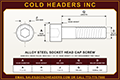
Open up any modern machine tool, fixture, or automation cell and count the fasteners: the alloy steel socket head cap screw outnumbers everything else, and there's an engineering reason for it. A hex head bolt needs a wrench swung around it — which means every hex bolt on a design demands empty space that could have been used for something. A socket head cap screw wrenches from above, straight down its own axis. That one difference lets designers put screws at the bottom of pockets, space them closer together, and sink them flush into counterbores where nothing snags, catches chips, or interferes with a moving part. The compact cylindrical head isn't a style choice; it's what makes dense, clean machine design possible.
Strength closes the argument. Alloy steel socket head cap screws are the strongest standard screw you can buy off a shelf — stronger than a Grade 8 hex bolt — which means a designer can spec a smaller diameter for the same clamp load, and the smaller screw needs a smaller counterbore, which buys back even more room. Machine building, tooling and fixture construction, dies, automation systems, material handling equipment, and precision assemblies all run on that math, and maintenance departments keep these screws in the crib because the deep, crisp hex socket survives repeated service without rounding.
Our online catalog includes many commonly requested alloy steel socket head cap screw sizes, but it does not represent every configuration we can supply. Non-catalog diameters, special lengths, and difficult-to-source items are quoted every week — it's much of what we do.
If the exact alloy steel socket head cap screw required for your application is not shown, there is a good chance we can still quote or supply it.
Call 773-775-7900 or email Sales@coldheaders.com for pricing, availability, or a quote.
Alloy Steel Long Length Socket Head Cap Screws
Long length alloy steel socket head cap screws pick up where standard catalog ranges leave off. Every diameter has a customary stopping point — the longest length most suppliers list — and this category holds what lies beyond it: the extra-long alloy steel socket head cap screws that machine builders, fixture designers, and maintenance shops reach for when a standard length simply won’t span the job.
The selection covers diameters from #0-80 through 3/4", with lengths running well beyond typical listings — many past a foot. These are the hard-to-find lengths: called for when through-bolting thick sections, clamping tall stacks, or reaching through housings and spacers where common sizes run out.
Cold Headers has been a master distributor of socket screws since 1962, and long lengths have always been part of the bench. Standard lengths for every diameter remain in our main Alloy Steel Socket Head Cap Screws listing — this category is the extension of each size range beyond it.
Pricing on long lengths varies with material and machining, so items here are quoted individually. Contact us with the size and quantity and we’ll respond promptly — and if a length you need isn’t shown, ask. The range published here reflects what we can supply, and it keeps growing as we continue putting our inventory online.
Alloy Steel Large Diameter Socket Head Cap Screws
This category gathers the largest diameters in our alloy steel socket head cap screw line — 7/8-9, 1-8, 1 1/4-7, and 1 1/2-6 — in lengths that run from under an inch up through 12 inches. These are the sizes that anchor heavy equipment, large fixtures, and other big-bore assemblies where a standard cap screw isn't enough fastener.
Every size here carries the internal hex drive and head proportions the socket cap style is known for, scaled up into serious bar-stock territory. Where a price is shown, it is quoted per 100 pieces; sizes marked Call or Email are quoted individually — reach us either way and we'll turn the number around quickly.
If the diameter or length you need isn't listed, ask. Large sizes are a specialty of the house, and our hard-to-find fasteners service covers odd lengths and configurations beyond what appears on this page.
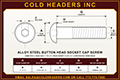
Look at where button head socket cap screws get used — machine guards, access panels, covers, conveyor systems, packaging machinery, material-handling assemblies — and a pattern emerges: these are all places where things move past the fastener. Hands, product, belts, cables, clothing. The button head is built for exactly that traffic: a low, smoothly rounded dome with no wrench flats, no sharp corners, and barely any projection, so whatever brushes against it slides off instead of snagging. A hex bolt in a guard panel is a hook waiting for a sleeve; a button head is a speed bump. That's why safety-conscious machine builders default to them on anything an operator touches — and it doesn't hurt that a field of matching low domes makes exposed hardware look deliberate rather than merely attached.
The internal hex drive carries its usual advantage — positive engagement from directly above, no wrench clearance needed around the head. But an honest boundary belongs here too: the button's low dome means a shallower socket and a smaller head than a standard socket head cap screw of the same diameter, and it can't develop the same preload. It's the right screw for panels, guards, brackets, and fixtures; it is not a substitute for a socket head cap screw in a strength-critical joint. Choosing the button head for what it's good at — and only that — is what keeps both screws' reputations intact.
Our online catalog includes many commonly requested alloy steel button head socket cap screw sizes, but it does not represent every configuration Cold Headers can supply. Non-catalog sizes, special lengths, and difficult-to-source items are available by request.
Call 773-775-7900 or email Sales@coldheaders.com for pricing, availability, or a quote.
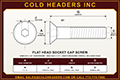
The button head lowers the fastener's profile; the flat head socket cap screw eliminates it. Properly seated in its countersink, the head sits dead flush — the surface stays a surface, with nothing above the plane at all. That's the requirement in places where something must travel across the mounting face rather than merely near it: tooling plates that product slides over, machine guarding and enclosure faces, wipers and seals, mating parts that clamp against the panel, robotics and automation assemblies where every protrusion is a collision waiting for a program error. Where a surface has a job to do, the 82° countersunk head gets the fastener out of its way completely.
Here's the part of flat head selection most catalogs skip: with this screw, half the fit is machined into your part, not the screw. The conical head seats against the countersink cone, which means the countersink — its 82° angle and its diameter — determines whether the head lands flush, sits proud, or sinks below the surface. The cone even self-centers the screw as it tightens. So confirm the head diameter against your countersink before ordering: too small a countersink leaves the head standing proud, too large lets it over-travel below flush. Individual product pages list exact head diameter, thread size, length, body diameter, and hex socket size precisely so that check takes thirty seconds.
One honest note: machining a cone into a screw head removes material, so the flat head is the lightest-duty of the three alloy head styles, with a smaller hex socket than a socket head cap screw of the same diameter. It's chosen for geometry, not maximum clamp load — for strength-critical joints, the standard socket head cap screw remains the tool.
Cold Headers has supplied specialty socket fasteners since 1962, and our alloy flat head range runs deep into the uncommon lengths and difficult-to-source configurations that send other counters to a "no stock" answer. If the size you need isn't listed, there's a good chance we can quote or supply it.
Call 773-775-7900 or email Sales@coldheaders.com for pricing, availability, or a quote.
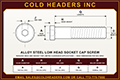
Sometimes the problem isn't the space around the screw — it's the space above it. A slide passes over the mounting surface, a panel closes against it, a housing sits two millimeters proud of where a standard cap screw head would reach. The low head socket cap screw is built for exactly that height budget: the same cylindrical head and internal hex drive as a standard socket head cap screw, with the head height cut roughly in half. Robotics, automation equipment, inspection fixtures, packaging machinery, machine guarding, compact assemblies — anywhere the design stacks components tightly in the vertical direction, this is the screw that fits under the lid.
What makes it the practical answer — rather than just the short answer — is what it doesn't require. A flat head screw also gets out of the way, but it demands an 82° countersink machined into the part. A low head screw works in a plain clearance hole or a shallow counterbore, with a flat bearing surface under the head doing normal cap-screw duty. That makes it the natural retrofit: when a design change or a repair puts something new in the flight path of an existing screw head, a low head screw threads into the same tapped hole with no re-machining at all — same thread, half the altitude. Machine builders keep them on hand for precisely those mid-life design collisions.
The honest trade is stamped into the geometry: half the head height means a shallower hex socket taking a smaller key, so a low head screw accepts less installation torque and delivers less clamping capability than a standard socket head cap screw of the same diameter. It's a clearance solution, not a strength upgrade — select it where headroom governs, keep the full-height screw where preload governs, and never swap one for the other without checking which of those is actually in charge of the joint.
Cold Headers supplies alloy steel low head socket cap screws in a range of inch thread sizes and lengths, including uncommon and difficult-to-source configurations — low heads are a thin-stock item industry-wide, which is exactly why we carry them. Individual product pages list exact thread size, length, head diameter, head height, and hex socket size so the clearance check takes seconds. If the size you need isn't shown, there's a good chance we can quote or supply it.
Call 773-775-7900 or email Sales@coldheaders.com for pricing, availability, or a quote.
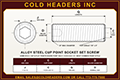
Alloy steel cup point socket set screws are headless threaded fasteners designed to secure gears, pulleys, collars, hubs, knobs, handles, and other components to shafts or mating parts. The internal hex socket allows installation through compact openings, while the cup-shaped point creates concentrated rim contact against the mating surface.
Cup point geometry is commonly selected when localized holding contact is needed to help resist movement between assembled components. Depending on the mating material and installation conditions, the point may create a witness mark or indentation on the contacted surface. These fasteners are frequently used in machinery, tooling, automation equipment, conveyor systems, packaging equipment, adjustment mechanisms, fixtures, maintenance repairs, and replacement assemblies.
Cold Headers supplies alloy steel cup point socket set screws in a broad range of inch thread sizes and lengths, including uncommon and difficult-to-source configurations. Individual product pages provide exact thread size, screw length, nominal diameter, hex socket size, cup point diameter, and other verified technical information where available. Review the listed dimensions along with the mating material, drive access, shaft condition, required holding action, and whether surface marking is acceptable.
Begin by confirming the required thread size and screw length. Then review the hex socket size to ensure the correct installation tool is available. Cup point diameter, mating-surface material, available access, and the allowable level of surface marking should also be considered. Cup point set screws should not be substituted automatically for flat, oval, cone, or dog point styles because each point geometry creates a different contact condition.
Cold Headers Inc. has supplied specialty industrial socket fasteners since 1962. Our catalog is organized to help engineers, distributors, maintenance teams, and purchasing professionals locate exact sizes, uncommon lengths, and hard-to-find socket set screws without unsupported inventory claims.
Call 773-775-7900 or email Sales@coldheaders.com for pricing, availability, or a quote.
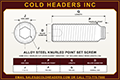
A standard cup point holds by biting into the shaft. The knurled cup point does that and then adds a second mechanism: serrations cut around the rim of the cup that embed themselves into the mating surface as the screw seats. Those teeth resist rotation — specifically, the slow reverse rotation that vibration works on every threaded fastener. Under sustained shake, a plain set screw can walk itself loose a fraction of a degree at a time; the knurled cup's serrations act like a ratchet against exactly that motion. It's the closest thing to a self-locking set screw that doesn't involve a nylon patch or threadlocker, which is why it's the default pick for conveyor systems, packaging machinery, vibratory equipment, power-transmission components, and any collar, gear, sprocket, or pulley that lives on a machine that never stops shaking.
The rest of the format is standard socket set screw: headless, so the installed fastener sits within or below the surrounding surface, driven by an internal hex socket that works inside compact assemblies. Alloy steel construction backs the point with the hardness the serrations need to embed rather than flatten.
Two honest boundaries. First: those serrations hold by digging in, which makes this the most surface-aggressive point in the set screw family — it will leave a pronounced witness mark, so it has no business on a ground, polished, or coated shaft; that's what our nylon tip and brass tip set screws exist for. Second: this is a set-and-leave fastener. Every removal and re-seating cuts a fresh ring of marks and dulls the old grip, so for assemblies that get repositioned regularly, a plain cup point — or a soft-tip screw — is the better tool. Point geometry isn't interchangeable; each style creates a different contact condition, and the knurled cup earns its place specifically where vibration is the enemy and the shaft surface is expendable.
Cold Headers supplies alloy steel knurled cup point socket set screws in a range of inch thread sizes and lengths, including the uncommon and difficult-to-source configurations this niche point style is known for. Individual product pages list exact thread size, length, hex socket size, and point dimensions. If the size you need isn't shown, there's a good chance we can quote or supply it.
Call 773-775-7900 or email Sales@coldheaders.com for pricing, availability, or a quote.
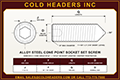
Every other set screw point holds by pressing against the shaft. The cone point is at its best when there's a hole waiting for it. Standard practice pairs this screw with a shallow drilled dimple or spotting hole in the mating part: drive the sharply tapered point into that recess and the connection stops depending on friction altogether — it becomes a mechanical interlock, steel seated in steel. Used that way, a cone point delivers the highest holding power of any standard point style, both against rotation and against axial sliding, which is why it's the choice for permanent locating, indexing assemblies, and connections that must never creep: collars, hubs, gears, sprockets, and shaft-mounted components in machinery, automation equipment, conveyors, tooling, and fixtures.
The sharp taper earns its keep in two other places. In softer mating materials, the point penetrates and seats deeply on its own, no dimple required. And because the tip is a precise, hardened point, cone point set screws also serve as adjustable pivots and locators — a screw whose end is the working surface, not just the clamp. The rest of the format is standard: headless, sitting flush or below the surrounding surface, driven by an internal hex socket in confined spaces.
The honest boundaries follow directly from the geometry. On a hard, unprepared shaft, all that concentrated force lands on a tiny tip that can blunt or skate rather than grip — for plain-shaft holding without a dimple, a cup point is the better tool, and for vibration service the knurled cup exists. The cone also leaves the deepest witness mark in the family; it's chosen precisely because its engagement is permanent, so it doesn't belong on finished shafts or in assemblies that reposition. Point geometries aren't substitutes for one another — each creates a different contact condition, and the cone's is the most deliberate of them all: it asks you to prepare the shaft, and pays you back with a connection that behaves like a machined feature.
Cold Headers supplies alloy steel cone point socket set screws in a wide range of inch thread sizes and lengths, including the uncommon and difficult-to-source configurations that pointed set screws are notorious for. Individual product pages list exact thread size, length, hex socket size, and point dimensions. If the size you need isn't shown, there's a good chance we can quote or supply it.
Call 773-775-7900 or email Sales@coldheaders.com for pricing, availability, or a quote.
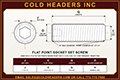
Cup points bite, knurled cups embed serrations, cone points want a dimple drilled for them — every one of those styles holds by altering the shaft. The flat point is the family's diplomat: a flat, hardened face that presses against the mating surface and holds by clamping force spread across the full contact area, leaving the shaft essentially as it found it. That distribution of force is the entire selection logic. Where a pointed style concentrates everything on a tip or rim, the flat point trades a little grip for a lot of mercy — which makes it the right screw for repeated adjustments and repositioning, where a biting point would carve a new divot at every setting, and for hardened shafts, which a cup point can't meaningfully penetrate anyway.
The textbook pairing deserves its own sentence: a flat point bearing against a machined flat on the shaft. Face against face, the connection gets solid rotational holding with no marring at all — the shaft flat does the anti-rotation work, the screw supplies the clamp. Machine designers spec this combination constantly for collars, hubs, pulleys, gears, and adjustment mechanisms that must be set, moved, and set again across years of service. The flat face also makes this the point of choice when the screw is doing duty as a pusher — bearing against a part in an adjustment or alignment mechanism where a pointed tip would gouge what it touches.
Honest boundaries, both directions. Holding power on a plain round shaft is friction-only, so it's below what a cup point delivers — if the assembly is set once and must never move, and the shaft can afford the mark, the cup is the stronger hold. And while the flat point is the gentlest of the hardened styles, hard steel under clamping load can still leave a light witness mark; when the shaft is ground, polished, or coated and the finish is genuinely untouchable, our nylon tip and brass tip set screws exist for exactly that job. Point geometries aren't substitutes — each creates a different contact condition, and the flat point's is the one you pick when the shaft outranks the screw.
Cold Headers supplies alloy steel flat point socket set screws in a wide range of inch thread sizes and lengths, including uncommon and difficult-to-source configurations. Individual product pages list exact thread size, length, hex socket size, and point dimensions. If the size you need isn't shown, there's a good chance we can quote or supply it.
Call 773-775-7900 or email Sales@coldheaders.com for pricing, availability, or a quote.
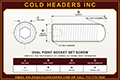
Alloy steel oval point socket set screws are headless threaded fasteners designed to secure collars, hubs, gears, pulleys, knobs, handles, and other components to shafts or mating parts. The internal hex socket allows installation in confined spaces, while the rounded oval point provides smooth surface contact with the mating component.
Oval point geometry is commonly selected where frequent adjustment or repositioning is anticipated and reduced surface marking is preferred. Unlike cup or cone point designs that concentrate force at a small contact area, the oval point provides broader, rounded contact that may help minimize marring of the mating surface while still providing reliable positioning in appropriate applications. Final selection should consider shaft material, required holding force, acceptable surface marking, drive access, and service conditions.
These fasteners are frequently used in machinery, automation equipment, fixtures, tooling, adjustment mechanisms, positioning assemblies, conveyor systems, collars, hubs, pulleys, gears, and maintenance applications where components may require periodic repositioning or adjustment.
Cold Headers supplies alloy steel oval point socket set screws in a broad range of inch thread sizes and lengths, including uncommon and difficult-to-source configurations. Individual product pages provide exact thread size, screw length, nominal diameter, hex socket size, point style, and other verified technical information where available.
Begin by confirming the required thread size and screw length. Review the hex socket size to ensure the proper installation tool is available. Mating-surface material, required holding force, allowable surface marking, available drive access, and expected maintenance requirements should also be considered. Oval point set screws should not be substituted automatically for cup, knurled cup, cone, flat, half dog, or full dog point styles because each point geometry creates a different contact condition.
Cold Headers Inc. has supplied specialty industrial socket fasteners since 1962. Our catalog helps engineers, distributors, maintenance teams, and purchasing professionals locate exact sizes, uncommon lengths, and difficult-to-find alloy steel socket set screws without unsupported inventory claims.
Call 773-775-7900 or email Sales@coldheaders.com for pricing, availability, or a quote.
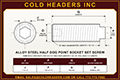
Alloy steel half dog point socket set screws are headless threaded fasteners designed to secure collars, hubs, gears, pulleys, sprockets, knobs, handles, and other components to shafts or mating parts. The internal hex socket allows installation in confined spaces, while the cylindrical half dog point projects beyond the threaded portion to engage a locating hole, groove, or mating recess.
Half dog point geometry is commonly selected where accurate positioning and repeatable component alignment are important. The reduced-diameter locating tip helps position the fastener without relying solely on point pressure against the shaft surface. Depending on the application, the dog point may engage a drilled hole, slot, or machined recess to help maintain alignment while allowing the threaded portion to provide clamping force. Final selection should consider the mating geometry, engagement depth, shaft material, available drive access, and assembly requirements.
These fasteners are frequently used in machinery, indexing mechanisms, tooling, fixtures, collars, hubs, couplings, pulleys, gears, automation equipment, adjustment assemblies, and maintenance applications where repeatable positioning or positive location is required.
Cold Headers supplies alloy steel half dog point socket set screws in a broad range of inch thread sizes and lengths, including uncommon and difficult-to-source configurations. Individual product pages provide exact thread size, screw length, nominal diameter, hex socket size, dog point dimensions, and other verified technical information where available.
Begin by confirming the required thread size and screw length. Review the hex socket size to ensure the proper installation tool is available. Dog point diameter, dog point length, mating-hole dimensions, available drive access, and overall assembly requirements should also be considered. Half dog point set screws should not be substituted automatically for cup, knurled cup, cone, flat, oval, or full dog point styles because each point geometry serves a different mechanical function.
Cold Headers Inc. has supplied specialty industrial socket fasteners since 1962. Our catalog helps engineers, distributors, maintenance teams, and purchasing professionals locate exact sizes, uncommon lengths, and difficult-to-find alloy steel socket set screws without unsupported inventory claims.
Call 773-775-7900 or email Sales@coldheaders.com for pricing, availability, or a quote.
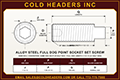
Full dog point alloy steel socket set screws are headless threaded fasteners designed to accurately locate and secure collars, hubs, gears, pulleys, couplings, knobs, handles, and other shaft-mounted components. The internal hex drive allows installation in confined spaces, while the extended cylindrical full dog point projects beyond the threaded portion to engage a mating hole, groove, or machined recess for repeatable positioning and alignment.
Unlike point styles that rely primarily on contact with the shaft surface, full dog point set screws are commonly selected where the locating feature of the extended dog point is an integral part of the assembly. The cylindrical projection helps position mating components while the threaded section secures the assembly. These fasteners are frequently used in machinery, indexing mechanisms, automation equipment, tooling, fixtures, couplings, conveyor systems, power transmission equipment, maintenance repairs, and OEM manufacturing where accurate positioning is essential.
Manufactured from alloy steel, these socket set screws are intended for demanding industrial mechanical applications. Proper fastener selection should consider thread size, screw length, dog point diameter, dog point length, mating-hole dimensions, installation access, and assembly requirements. Individual product pages provide verified engineering dimensions to assist engineers and purchasing professionals in selecting the appropriate fastener.
Cold Headers supplies full dog point alloy steel socket set screws in a broad range of inch thread sizes and lengths, including uncommon and difficult-to-source configurations. Our catalog is organized to simplify exact-size sourcing while providing consistent engineering information across every product family.
Begin by confirming the required thread size and screw length. Review the dog point diameter, dog point length, mating-hole dimensions, installation clearance, and assembly requirements before selecting a fastener. Full dog point set screws should not be substituted automatically for cup point, knurled cup point, cone point, flat point, oval point, or half dog point styles because each point geometry serves a different mechanical function.
Cold Headers Inc. has supplied specialty industrial socket fasteners since 1962. Our catalog helps engineers, distributors, maintenance teams, and purchasing professionals locate exact sizes, uncommon lengths, and difficult-to-find alloy steel socket set screws without unsupported inventory claims.
Call 773-775-7900 or email Sales@coldheaders.com for pricing, availability, or a quote.
